
13 Development Delay Balancing Exercises
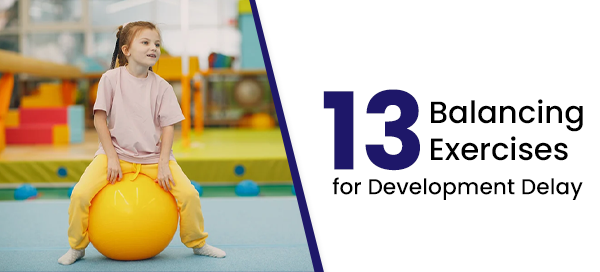
Children with Development delay usually experience strength, coordination, and balance problems, and as a result, their overall motor skills and activities of daily living are affected. Certain exercises for development delay actually enhance balancing, posture, and muscle strength of the children. These exercises construct better motor control and confidence, and therefore are more self-independent in activity of daily life. In this post, we shall present 13 balance exercises for Development Delay to improve coordination and child strengthening. Why is Balance Training Needed for Development Delay? Balance is crucial in performing basic activities like sitting, walking, and running. Developmentally delayed children have poor postural control, and thus movement is impaired. Training for balance increases: These exercises for developmental delay can be integrated into daily activities so that the patients can become engaged in therapy in an active and productive way. Customized balance training programs can be offered by best pediatric physiotherapy clinic in Jaipur to meet the requirements of developmentally delayed children in such a way that appropriate support is provided in order to promote progress as well as autonomy. 13 Effective Balancing Exercises for Development Delay Balance exercises are a crucial part of children with developmental delay as they improve motor function, tone, and coordination. All of these exercises focus on increased postural control and autonomy of the body. The following is the correct description of the medium of these exercises, why exactly they are so vital, and how to carry them out effectively. 1. Single Leg Stance Exercise One of the best methods of enhancing balance and stability is by the single leg stance. This exercise for development delay starts when the child stands on a single leg with the help of one hand or a wall. As they grow more independent, the support decreases so that they can feel independent balance control. The exercise also tightens the muscles of the legs, particularly the ankles, and keeps the core firm. Besides it, it assists in proprioception, enabling children to comprehend the body position in space more effectively, in preparation for movement planning, coordination, and overall movement assurance. This will be of assistance in the acquisition of motor skills. Besides, interventions like Neurodevelopmental Therapy offer further assistance in best development assessment. 2. Heel-to-Toe Walking Exercise Heel-to-toe walking is exercised as one dynamic means of enhancing posture and gait. This activity requires coordination and balance on the part of the child as he/she walks in a straight line, one foot coming directly into the path of the other. The children strengthen the ankles’ and feet’ muscles by controlling the position in which each step places its weight, thus enhancing walking stability. Heel-to-toe walking improves space perception and higher motor planning in children, and it is essential for daily functioning and locomotion to reduce development delay. These exercises for development delay are intended to assist in better movement strategy. 3. Walking on a balance beam Balance beam walking is among the fundamental development delay exercises that can be used to improve coordination and also spatial perception. The child balances on a narrow beam, therefore, they must constantly realign their balance with each step. The exercise for development delay stabilizes the core and leg muscles that are required for correct posture and independent walking. The balance beam also facilitates correct postural alignment and control, thus aiding the ability of the child to make more complicated movements. For delayed development, this activity is used to establish mobility motor skills. These will be put towards muscle strength and posture control. Contact Milestone PRC today and begin your child’s road to increased balance and coordination through the use of our experienced pediatric physiotherapist. 4. Wobble Board Training for Development Delay Wobble board training provides an innovative method through which proprioception, balance, and coordination can be enhanced in children. As part of exercises for development delay, in this activity, the child makes small corrections to maintain balance, using the stabilizing muscles of the lower limbs and the core. The instability of the board facilitates the process of developing ankle stability and motor control, both essential for walking and running. Aside from this, it also enhances sensory-motor integration and sensitizes the child to changes in balance and other movement throughout the day. These exercises enhance fine motor skills and reaction times. 5. Bosu Ball Balancing A Bosu ball is a great exercise for development delay because it is an unstable surface that forces children to engage stabilizer core muscles. The child sits or stands on the ball and has difficulty maintaining balance, posture and coordination muscles being conditioned. Instability of the ball causes sensory processing through by causing the child to accommodate varying levels of instability. Occupational Therapy uses the exercise to aid in improving body awareness, motor coordination, and general stability, all of which are essential to the maintenance of physical independence. These development delay exercises are superb for developing body awareness. 6. Seated Balance on a Therapy Ball Seated balance on a therapy ball is a great development delay exercise that engages the core strength and stability. The child sits on an inflated therapy ball, sitting upright on it with his or her core muscles. Not only does it improve trunk control, but it also improves spinal alignment and posture. With increased confidence, the child can hop on one foot and also acquire independent sitting and standing muscle strength. It is also extensively employed in early intervention for the formation of bases for more advanced movements. Visit Milestone PRC in Jaipur, and allow your child to develop better posture, balance, and confidence of movement. 7. One-Foot Hopping One-foot hopping is an enjoyable and therapy exercise for development delay since it facilitates strengthening and balance increase among children. The child has to hop on one foot alternately, which strengthens the muscles of the legs and enhances coordination. The exercise promotes unilateral coordination by enhancing single-leg stability. One-foot hopping also improves balance by placing challenges on the child to stabilize the body in movement. For children with delayed
