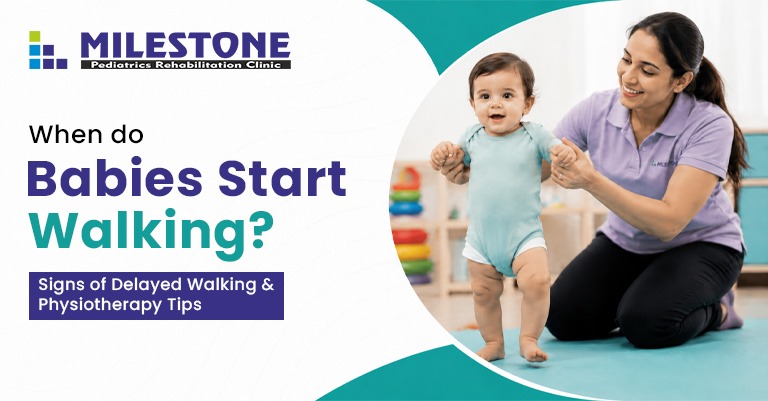
Are you monitoring your child’s crawling style and silently willing them to just let go of the couch and walk independently? Take a breath first. Most babies take their first independent steps somewhere between 9 and 18 months. They usually learn to walk after getting practice to sit, crawl, pull to stand and cruise along furniture.
This guide walks through the typical walking timeline, the signs that suggest a baby is close to walking and the red flags for delayed walking that are worth acting on. We’ll also discuss how a pediatric physiotherapy clinic in Jaipur can help if independent walking hasn’t started as expected.
At What Age Do Babies Usually Start Walking?
Many babies start walking between 9 and 15 months. Some walk a little earlier, and others reach it closer to 18 months. Walking by this period usually comes under the expected range. Don’t compare your younger one’s walking timeline with other children or siblings; each of them has their own pace.
The table below outlines how this sequence generally progresses among most babies:
| Baby’s Age | Common Walking-Related Milestone |
| 6–8 months | Sitting with support or independently |
| 8–10 months | Crawling, rolling, or other attempts to move |
| 9–12 months | Pulling to stand, standing with support |
| 10–14 months | Cruising along furniture |
| 12–15 months | First independent steps |
| 15–18 months | More confident, steadier independent walking |
Signs Your Baby May Be Ready to Walk
Recognising pre-walking signs helps parents to understand how much their baby has developed since birth. Some of the common signs that indicate your baby is ready to walk are:
- Pulling up to stand using furniture or a caregiver’s support
- Cruising sideways along a sofa or low table
- Standing without support for several seconds at a time
- Squatting and returning to a standing position independently
- Taking several steps while holding one or both hands
- Improved balance while sitting, kneeling or standing
- Pushing a stable toy forward while standing behind it
What Is Delayed Walking in Babies?
Delayed walking among babies means the baby has not learned to walk independently after 18 months of birth. This timeline is not a diagnosis since many babies who have this condition are simply later walkers with no underlying issues.
Difference Between Normal Late Walking and Developmental Delay
Only late walking in a baby can be a normal part of growth with no accompanying signs of other areas of development. On the other hand, a developmental delay refers to conditions when a baby cannot walk along with muscle weakness, stiffness, poor balance or delays in other milestones such as crawling or speech.
Why Is Early Assessment Helpful?
An early assessment of your child’s growth can help you know how well they are developing in terms of height, walking, speech or crawling. If a baby shows signs of late development, a paediatrician can evaluate the medical and neurological reasons behind the delayed growth. More specifically, a paediatric physiotherapist can conduct a more detailed evaluation of strength, muscle tone and coordination.
Signs of Delayed Walking Parents Should Not Ignore
Sometimes late walking among babies may suggest that the baby’s motor development requires medical attention. The following indicators are worth raising concerns related to the walking ability of your baby with a paediatrician:
Baby Is Not Standing With Support
Most of the babies can stand with support by around 9 to 12 months. If your baby often avoids bearing weight through their legs or resists standing even when held upright, then you should visit a paediatric clinic.
Baby Is Not Pulling to Stand
Among babies, it is common to pull themselves up on furniture between 9 and 12 months. If a baby shows no attempt to do this activity even after 12 months of birth, then it should be discussed with a paediatrician.
No Cruising Around Furniture
Cruising among babies bridges standing and independent steps. It usually appears between 10 and 14 months of age. A baby who stands by themselves for some time but does not show an attempt to move sideways along the furniture may require an evaluation of balance and leg strength.
Baby Walks Only on Toes
Occasional walking on toes is quite common among babies. However, if the baby most of the time walks on toes when they are becoming 3 years old, it is better to consult a paediatrician.
One Side Looks Weaker
If a baby drags one leg, one foot turns in or out more than the other, or consistently favours one side when standing or walking, this condition urgently requires medical attention. In such cases, a paediatrician or physiotherapist can determine whether the difference is related to muscle strength, tone or other underlying causes.
Very Stiff or Very Floppy Muscles
Among babies, muscle tone that is unusually rigid or loose may affect standing and walking. Both extremes of a baby’s tone should be diagnosed by a paediatrician because tone-related issues are generally easier to address when identified earlier.
Frequent Falling or Poor Balance
It is normal for a baby to fall frequently or have poor balance if they have started to walk a few weeks ago. However, if they show similar symptoms even after 18 months, it calls for medical attention.
Delay in Other Milestones
You should book an appointment with a paediatrician right away if your child’s walking is delayed along with crawling issues, muscle weakness, speech or stability. The combination of these issues may indicate development concerns.
Common Causes of Late Walking in Babies
Late walking among babies has several possible reasons. Some of them are as follows:
- Normal variation between babies, with no identifiable cause
- Premature birth, where corrected age accounts for much of the apparent delay
- Low muscle tone, which can make standing and stepping more tiring
- Weak core or leg muscles resulting from limited practice
- Limited tummy time in early infancy, which affects strength-building
- A slower pace through earlier stages such as sitting, standing, or cruising
- Tight calf muscles, which can affect foot position and balance
- Flat feet or general foot instability
- Neurological conditions, including cerebral palsy, in a smaller number of cases
- Vitamin D deficiency, which is uncommon in well-nourished infants but can affect bone and muscle development when present
- Heavy reliance on baby walkers or being carried for extended periods, which reduces the floor time needed to practice standing and stepping
Many late walkers do not indicate medical complications; it is a part of regular growth.
When Should Parents Worry About Baby Not Walking?
Some level of variation in walking among babies can be expected. However, some age-specific growth delays are red flags that can’t be ignored. To help you know which signs need close attention, here are some age-specific situations that need medical intervention:
| Age / Situation | What Parents Should Do |
| Not sitting by 9 months | Discuss with your paediatrician |
| Not standing with support by 12 months | Consider a developmental evaluation |
| Not cruising by 15–16 months | Monitor closely and raise it at the next visit |
| Not walking independently by 18 months | Consult a paediatrician or paediatric physiotherapist |
| Stiffness, weakness, toe-walking, or one-sided movement, at any age | Seek an assessment early |
As per the CDC guidelines, most babies achieve walking without holding support by the age of 18 months.
How Can Physiotherapy Help a Baby Start Walking?
Generally, a pediatric physiotherapy clinic in Jaipur assesses how your baby sits, walks and stands independently. Physiotherapists also pay attention to the child’s posture, foot position and age-wise milestone development. Depending on the assessment results, the physiotherapist creates a child-friendly therapy plan to improve walking style or to treat any development-related conditions among babies.
Physiotherapy may help with:
- Muscle strengthening
- Balance training
- Standing practice
- Gait training
- Core stability
- Posture correction
- Stretching tight muscles
- Improving coordination
- Parent-guided home exercises
Physiotherapy Tips to Encourage Walking at Home
Alongside pediatric therapy sessions, some physiotherapeutic activities encourage your baby to walk independently. To get the most effective results, practice the following activities consistently and adjust them accordingly as per your child’s current stage of development:
1. Encourage Floor Play
Give your baby some toys that move from point A to B, such as a car or walking stuffed toys. Time spent on the floor playing with such toys encourages babies to crawl or walk. Playing on the floor also allows babies to roll, reach and push against a firm surface. This activity builds the muscle strength that is required for standing and walking.
2. Practice Pull-to-Stand
Place a toy on a sofa cushion or low table; it encourages babies to pull up and hold the standing position for a longer period. This action strengthens the same muscle group that allows them to stand and walk independently.
3. Support Cruising
Allow your baby to move sideways while holding onto furniture; it provides repeated practice in shifting body weight from one leg to the other. This practice builds muscle and mind coordination that is needed for the transition to independent walking.
4. Use Push Toys Carefully
A weighted push toy lets your baby shift weight onto each leg without the toy rolling away. But you should avoid unsafe infant walkers because they move too fast for a baby’s legs and may cause harm.
5. Strengthen Core Muscles
Activities such as reaching for toys placed to the side or behind the back strengthen your child’s hip and trunk muscles that keep the pelvis level on one leg. You can also try out supported squats for babies, since it delivers similar results.
6. Barefoot Practice Indoors
Walking barefoot on a flat indoor surface lets your baby’s toes grip the floor, and the arch feel the surface. This activity helps the baby judge how far to lean before a step. You should also make sure that there are no sharp objects on the floor to prevent injuries.
7. Avoid Forcing Early Walking
Avoid forced walking practices such as pulling your baby up by the hands or repeatedly prompting steps before the legs and spine are developed. It does not speed up the child’s ability to improve walking and may strain their shoulders.
8. Make Walking Fun
To make walking fun, encourage your baby to move short distances and place their favourite toys just a few feet away to increase the urge to get them. Also, praise them by clapping or playing with them so that they repeat the same steps another time.
Things Parents Should Avoid
Some parenting habits may interfere with the baby’s natural progress towards walking or delay identification of an underlying issue. The following are a few practices that you must avoid:
- Avoid comparing a baby’s walking timeline to a sibling or another child
- Steer clear of forcing standing or walking before the baby shows signs of readiness
- Limit reliance on wheeled baby walkers for extended periods
- Do not ignore persistent toe-walking or a clear one-sided difference in movement
- Refrain from delaying a paediatrician visit well past 18 months if walking hasn’t started
- Skip online exercises for a baby with stiffness, pain or neurological signs, without a prior professional assessment
Why Choose a Pediatric Physiotherapy Clinic in Jaipur?
Finding the right physiotherapy clinic in Jaipur early can shape how confidently a child moves toward walking. A good clinic for babies and toddlers tends to have a few things in common:
- Location close enough that weekly or biweekly visits fit into a normal week
- A space set up for toddlers, with toys and low equipment they’re comfortable around
- An assessment that looks at posture, muscle tone, balance, coordination and foot position together, as one full picture
- Parents shown the home exercises directly, so they can continue the work between visits
- A plan built around this child’s own assessment, rather than the same routine for every patient
- Real experience with cases like delayed walking, cerebral palsy, toe-walking, and low muscle tone
If your child isn’t walking, standing, or cruising the way you’d expect, an assessment at a top pediatric physiotherapy clinic in Jaipur like Milestone is an appropriate step to understand what’s going on.
Final Takeaway
Many babies take their first independent steps between 9 and 18 months of age. The pace of independent walking within this range varies from child to child. Sometimes, delays in walking only are normal and resolve on their own. However, if a baby has delayed walking accompanied by muscle weakness, poor balance, crawling or speech problems, it needs medical attention. In these cases, a paediatrician or paediatric physiotherapist can help you take the next step for proper development among babies.
FAQs
1. When do babies usually start walking?
Babies typically start walking independently between the ages of 9 to 18 months.
2. Is it normal if my baby is not walking at 15 months?
Yes, most babies walk after 15 months without a problem.
3. When is walking considered delayed?
Walking can be considered delayed when the baby cannot walk independently by 18 months of age.
4. Can physiotherapy help with delayed walking?
Yes, physiotherapy can improve strength, balance and coordination as soon as the underlying cause of the problem is detected.
5. What are red flags for delayed walking?
The red flags of delayed walking are stiffness, weakness, toe-walking, one-sided walking pattern or developmental problems in other milestones besides walking.
6. Should I use a baby walker to help my baby walk?
No, wheel walkers must be avoided because of injury risk and no major developmental benefit.
7. Which clinic should I visit for delayed walking in Jaipur?
You should visit Milestone Pediatrics Rehabilitation Clinic for tailored, playful physiotherapy solutions for your child.