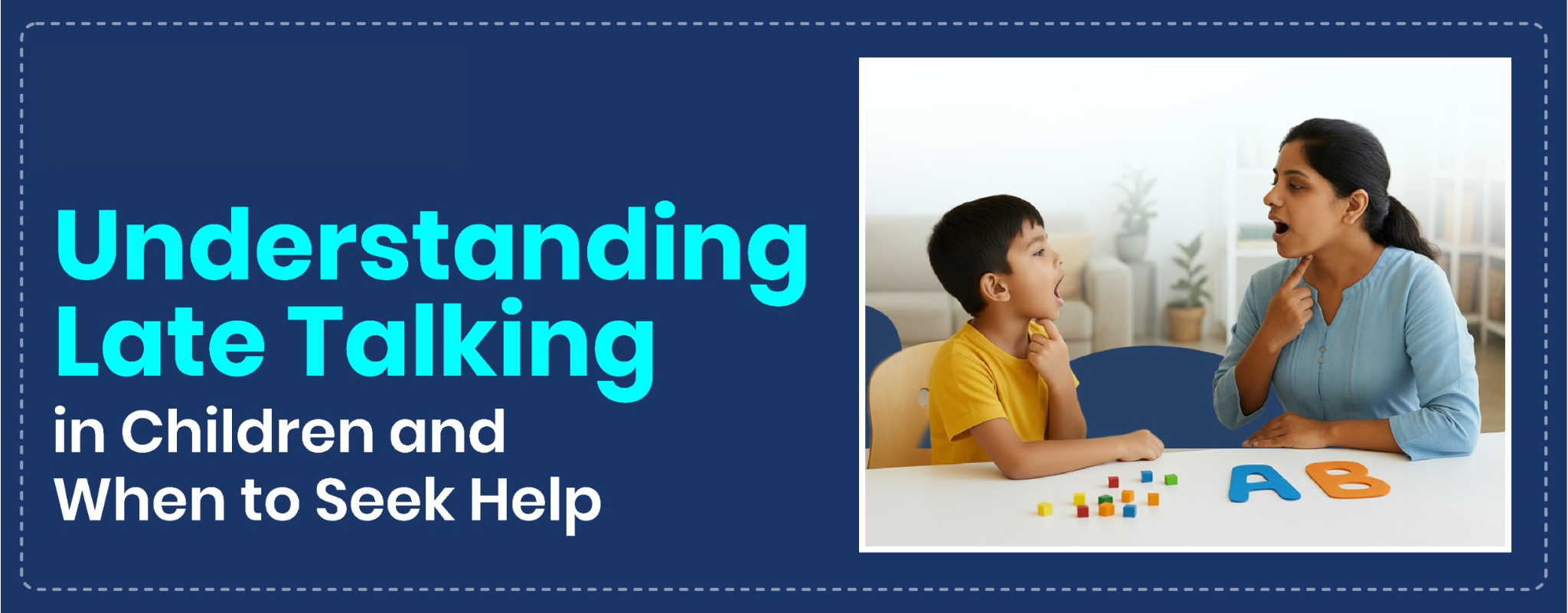
It is the concern of many parents that the child is not talking as much as other children of the same age. Such questions are quite common as, why is my child not talking yet? or is something wrong? Delays in talking may be very disorienting and stressful to the child particularly when the family members or friends begin to compare. The fact is that each child develops and studies differently. Other children can talk early in life, but some of them can take time. Late talking is quite normal in most instances. In other cases, it might require some consideration. Knowing the distinction also enables the parents to remain steady and make the correct action at the right moment.
Late Talking in Children: When Is It Normal and When Is It Not?
Late talking is when a child is late in beginning to talk in comparison to the majority of children of this age. This does not necessarily imply the existence of a severe issue.
A child can be termed as a late talker because:
• They have excellent command of language but they speak less than the age of the expected number of words.
Their speech development is retarded, yet other abilities such as play and movement are intact.
One should understand the difference between speech disorder and late talking. Late talking simply refers to delay in speaking but a speech disorder can be having difficulties in getting the language and in constructing sounds or in use of words in a proper manner.
Each child is developed at his or her pace. Similar to walking or eating habits, speech also develops in a different way to every child. Lateness does not necessarily imply that something is wrong.
Typical Speech Milestones by Age
Speech milestones provide an approximate representation of the many things that many children are capable of doing at various ages. They are not rules to be followed strictly.
• By 12 months
o Makes sounds like “ba,” “da,” or “ma”
o Babbles and uses gestures such as pointing or waving.
o Reacts to known voices.
• By 18 months
o Speaks few simple words such as mamma, dada, or ball.
o Tries to copy sounds
o Interprets single syllable words such as no and come.
• By 2 years
o Combines two words such as more milk or mom come.
o Vocabulary develops gradually and progressively.
o Able to follow straightforward instructions.
• By 3 years
o Speaks in short sentences
o Family members can understand speech better.
o Asks simple questions
The absence of one of the milestones does not imply that a child has an issue. The children tend to catch up themselves.
Milestone PRC provide Speech Therapy in Jaipur.
When Late Talking Can Be Normal
Late talking in most instances is normal. There are those children who put more emphasis on other skills and later speak.
Late talking may be normal if:
Specifically, there is a family history of late talkers.
• The child performs well in gestures, pointing and facial expression.
Even when the child speaks very little, he/she understands the instructions.
• Socially, everything is normal: social interaction and play.
There are no movement delays, delays in thinking, or delay in learning.
There are children who are mere spectators. They do not talk much and only listen before they speak. These children also tend to surprise the parents because one day they suddenly start using a lot of words simultaneously.
When Late Talking May Be a Concern
In some cases, the problem of late talking requires more attention. This is not panicking, but it is to be on the alert.
A concern may be late talking in case:
• The child fails to respond to his/her name.
There is minimal eye contact or interaction.
• The child has problems with comprehending simple instructions.
No improvement in speech after several months.
The child becomes extremely frustrated or tantrums frequently due to the inability to express himself/herself.
It is significant to use a soft level of awareness. Such signs are not to frighten the parents but to make them aware about the moment when additional assistance may be provided.
Common Causes of Late Talking in Children
Late talking may occur because of numerous reasons, and in a very rare case, this is because of only one reason.
• Hearing issues
Mild hearing issues can influence the learning of words in children.
• Less exposure to language
Children require repetition of the words to learn. Talking around them can be slowed down by less talking.
• Excessive screen time
The screens do not substitute the face-to-face communication. Excessive use of the screen may decrease the time of talking.
• Developmental delays
There are children who acquire such skills as speech slower than others do.
• Verbal motor or sensory problems
Other children are more difficult to control the movements of the mouth or the processing of sounds.
These reasons are not the fault of some one. The knowledge of them will enable parents to react with empathy rather than anxiety.
What Parents Can Do at Home
The role that parents play is very crucial in assisting children to develop speech. Even the little things one does on a daily basis can go a long way.
• Keep on talking to your child a lot about simple things you are doing.
• Read story books daily, although the child may not talk.
• Sing simple songs and rhymes
• Cut back on the time spent on screens and spending more face-to-face time.
• Promote taking a turn in communication, even in sounds / gestures.
The avoidance of pressure, coercion of words, and comparison with other children is advisable.
• Make language part of the day-to-day activities such as meals, bathes, and play.
Children learn in a secure, relaxed and motivated state.
When to seek professional help?
Waiting is not the most optimal option at times. Children can learn easily through early support.
Parents must take professional advice in case:
• By 18-24 months, there are minimal or no words in a child.
• The kid is a poor language learner.
Even in case others say wait, parents feel that something is not right.
It is significant to trust parental instincts. A request of assistance is not an indication that something is amiss. It merely involves providing the child with additional help at an early stage which may result in improved performance.
Conclusion: It Matters a Lot When one There Knows early
Children may talk a lot when they are late which is normal not always. Being aware of the things to be on watch assures the parents that they are in control and do not need to worry. When a family is informed early enough, the family can then take care and not be afraid. Support does not entail labelling a child. It is concerned with making them communicate more freely and joyous. Through proper guidance, patience and encouragement in due time, a lot of children end up making big steps and discover their voice.